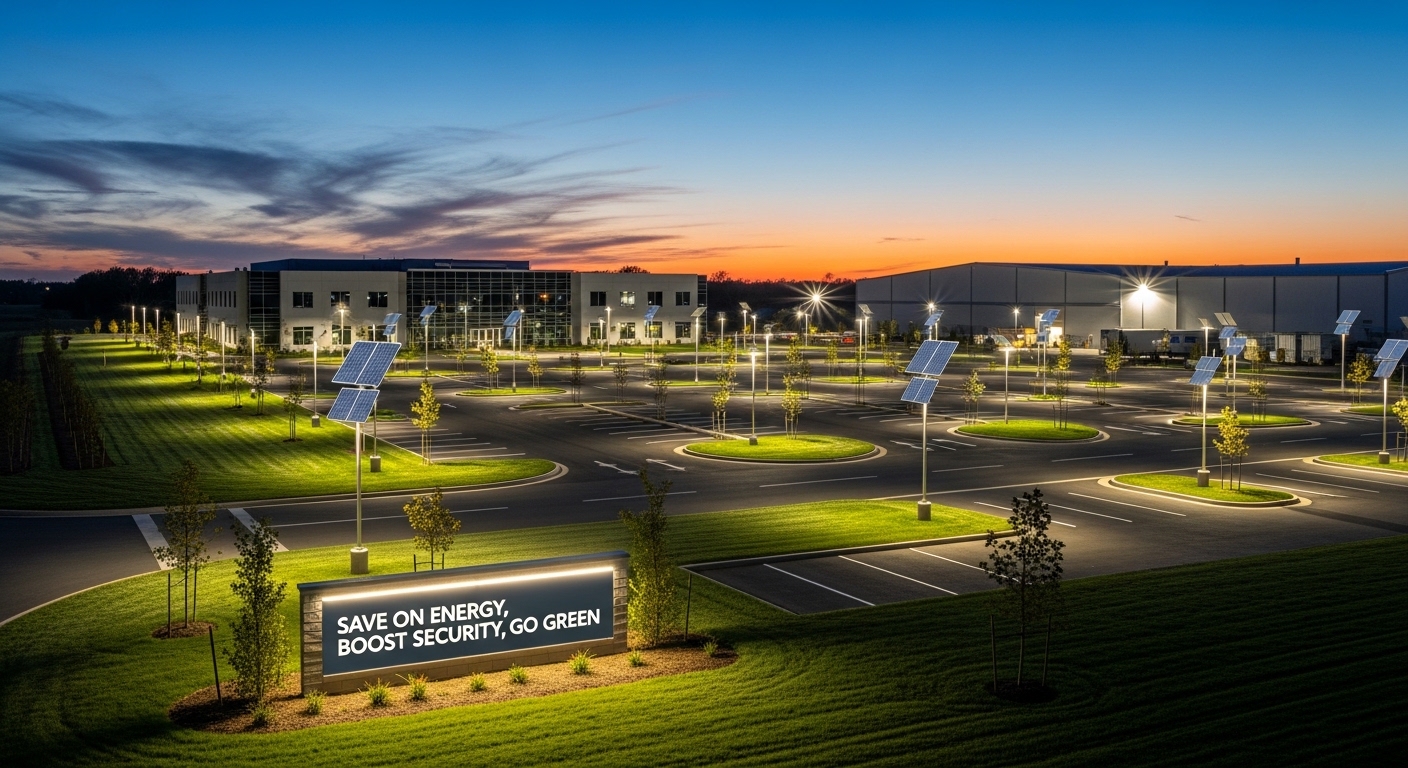
Commercial solar lights are changing how businesses light their properties. No wiring. No electricity bills. No grid dependency. Just clean, reliable light powered by the sun.
What Are Commercial Solar Lights?
Commercial solar lights are self-powered outdoor lighting systems. They collect sunlight, store energy in batteries, and produce light at night automatically.
They work in four steps:
- Solar panel collects sunlight
- Charge controller stores energy safely
- Battery holds power for nighttime use
- LED fixture produces light when needed
These systems are built tougher than residential solar lights. They handle extreme weather, long operating hours, and heavy-duty commercial use.
Why Businesses Are Switching to Commercial Solar Lights
The numbers make a strong case. No electricity cost. No trenching. No wiring permits. Installation is faster and cheaper than grid-powered systems.
Here is why businesses choose commercial solar lights today:
- No electricity bills — Solar energy is free after installation
- No underground wiring — Saves thousands in installation costs
- Works during power outages — Fully independent from the grid
- Installs anywhere — Remote areas, fields, and rural roads included
- Reduces carbon emissions — Clean energy with zero fuel cost
- Government rebates available — Many regions offer tax credits for solar upgrades
- Payback within 3–7 years — Long-term savings outweigh upfront costs
Wattage Explained: The Most Misunderstood Part
Most buyers focus only on wattage. That is a mistake.
Wattage tells you how much power the LED uses per hour. It does not tell you how bright the light is. It does not tell you how long it will run.
Three numbers actually matter in commercial solar lights:
| Component | What It Measures |
| LED Wattage | Power used per hour |
| Battery Capacity (Wh) | Total energy stored |
| Solar Panel Wattage | Energy collected daily |
All three must be balanced. A high-watt LED with a small battery will shut off early. A large panel with a tiny battery wastes potential. Good system design matches all three components together.
Lumens Matter More Than Watts
Lumens measure brightness. Watts measure power consumption.
Two 80W fixtures can produce completely different brightness levels. One might output 9,000 lumens. Another might only produce 6,500 lumens. The difference is LED quality and efficiency.
Here are real-world lumen benchmarks for commercial solar lights:
- 30W → 3,000–4,500 lumens → Best for walkways and paths
- 50W → 5,000–7,500 lumens → Good for small parking areas
- 80W → 9,000–12,000 lumens → Suitable for mid-sized lots
- 120W → 14,000–18,000 lumens → Covers large commercial spaces
- 200W → 24,000+ lumens → For roadways and industrial zones
Always ask for lumen output. Never buy based on wattage alone.
Choosing the Right Wattage for Your Application
Different spaces need different light levels. Matching wattage to the application prevents waste and underperformance.
Here is a simple breakdown based on real commercial use cases:
Pathways and Walkways — 30W to 50W
Pedestrian areas need soft, even light. High brightness causes glare. Lower wattage works well here when paired with the right beam angle and mounting height.
- Even light distribution matters more than intensity
- Anti-glare optics improve pedestrian safety
- Mounting height of 4–5 meters is typical
Parking Lots — 60W to 120W
Parking lots need broad, even coverage. Drivers and pedestrians both need clear visibility. Dark zones between poles create safety risks.
- Wider beam angles improve coverage between poles
- Higher mounting heights require higher wattage
- Uniform light across stalls reduces accident risk
Roadways and Streets — 120W to 200W
Roadways demand the highest performance. Light must reach far and wide. Pole spacing is typically larger, requiring more lumen output per fixture.
- Use photometric plans to verify coverage before buying
- Spacing-to-height ratio should stay between 3:1 and 4:1
- Motion dimming can extend battery life on low-traffic roads
Security and Perimeter Areas — 60W to 120W
Security lighting benefits from motion detection. Full brightness is not always needed all night. Smart dimming saves battery and delivers full output when movement is detected.
- Motion sensors trigger full brightness instantly
- Reduced output between events extends battery runtime
- Wide coverage angles reduce blind spots
How Mounting Height Affects Performance
Mounting height directly changes how much wattage you need. This is one fact many buyers overlook.
Higher pole = light travels farther = more lumen output needed.
A fixture at 4 meters lights a tight area below. That same fixture at 9 meters spreads light over a wider zone but with less intensity at ground level. You need more lumens to compensate.
Key mounting facts for commercial solar lights:
- Every extra meter of height reduces ground-level light intensity
- Higher poles need higher wattage to maintain safe light levels
- Always match wattage to mounting height, not just the coverage area
- Use photometric software to model results before installation
Climate and Location: Why They Change Everything
Location controls how much energy the solar panel collects each day. This directly affects how long the light runs at night.
A system that works perfectly in Arizona may fail in Seattle during winter. The difference is peak sun hours — the amount of quality sunlight available per day.
Peak sun hours by climate type:
- Sunny regions (Southwest US, Middle East): 5–7 hours/day
- Moderate regions (Central Europe, Mid-US): 3.5–5 hours/day
- Cloudy regions (Northern Europe, Pacific Northwest): 2–4 hours/day
What this means for buyers of commercial solar lights:
- Low-sun regions need larger panels and bigger batteries
- Design for worst winter conditions, not summer performance
- Partial shade from trees or buildings cuts output by up to 40%
- LiFePO4 batteries handle cold temperatures far better than lead-acid types
Must-Have Features in Quality Commercial Solar Lights
Not all commercial solar lights are built the same. These features separate reliable commercial systems from cheap residential-grade products.
- IP65 or higher rating — Fully weatherproof for outdoor use
- LiFePO4 battery — Lasts 7–10 years, handles cold, safer chemistry
- Motion sensor — Saves battery, improves security response
- Adaptive dimming — Reduces output at low-traffic hours automatically
- Monocrystalline solar panel — Higher efficiency than polycrystalline
- CRI 70 or above — Better color accuracy and visibility at night
- 5000K–5700K color temperature — Clear, bright white light for commercial areas
- 3–5 year warranty minimum — Confirms manufacturer confidence in product quality
How to Read a Solar Light Spec Sheet
Spec sheets reveal the truth behind marketing claims. Learn to read them before buying any commercial solar lights.
Five numbers to check first:
- Lumen output — Total brightness produced by the fixture
- Lumen efficacy (lm/W) — Efficiency of the LED (look for 130+ lm/W)
- Battery capacity (Wh) — Total stored energy available per night
- Solar panel wattage — Daily energy input capacity
- IP rating — Weatherproof protection level verified independently
If the spec sheet is missing any of these numbers, ask the supplier directly. No data usually means poor performance.
Certifications That Matter
Certifications protect your investment. They confirm that the product meets tested safety and performance standards independently verified by third parties.
Look for these when buying commercial solar lights:
- UL 8750 — LED safety standard for North America
- DLC Qualified — Required for most utility rebates in the US and Canada
- IP65/IP66 — Verified weatherproof protection rating
- IEC 62133 — Battery safety certification
- RoHS Compliant — Free of harmful materials, safe for disposal
Top Mistakes to Avoid
These errors cost businesses money every year. Avoid them from the start.
- Buying on wattage alone — Always check lumens and battery capacity together
- Ignoring local sun hours — Design for your actual climate, not ideal conditions
- Skipping photometric planning — Guessing pole placement leads to dark spots
- Choosing lead-acid batteries — They fail faster in cold and cycle far fewer times
- No post-installation testing — Always verify charging, dimming, and sensor function after setup
Quick Comparison: Solar vs. Grid-Powered Lighting
| Factor | Commercial Solar Lights | Grid-Powered Lights |
| Electricity cost | Zero | Ongoing monthly bills |
| Installation | No trenching needed | Trenching and wiring required |
| Power outage | Keeps working | Goes dark |
| Remote locations | Works anywhere | Requires grid access |
| Payback period | 3–7 years | No energy payback |
| Carbon emissions | Zero operational emissions | Depends on grid source |
Final Thoughts
Commercial solar lights are a smart, proven investment for any outdoor commercial space. They eliminate electricity costs, simplify installation, and deliver reliable performance for 15–25 years.
The key is proper selection. Match wattage to your application. Verify lumen output. Check battery capacity. Design for your local climate. Demand certified products.