
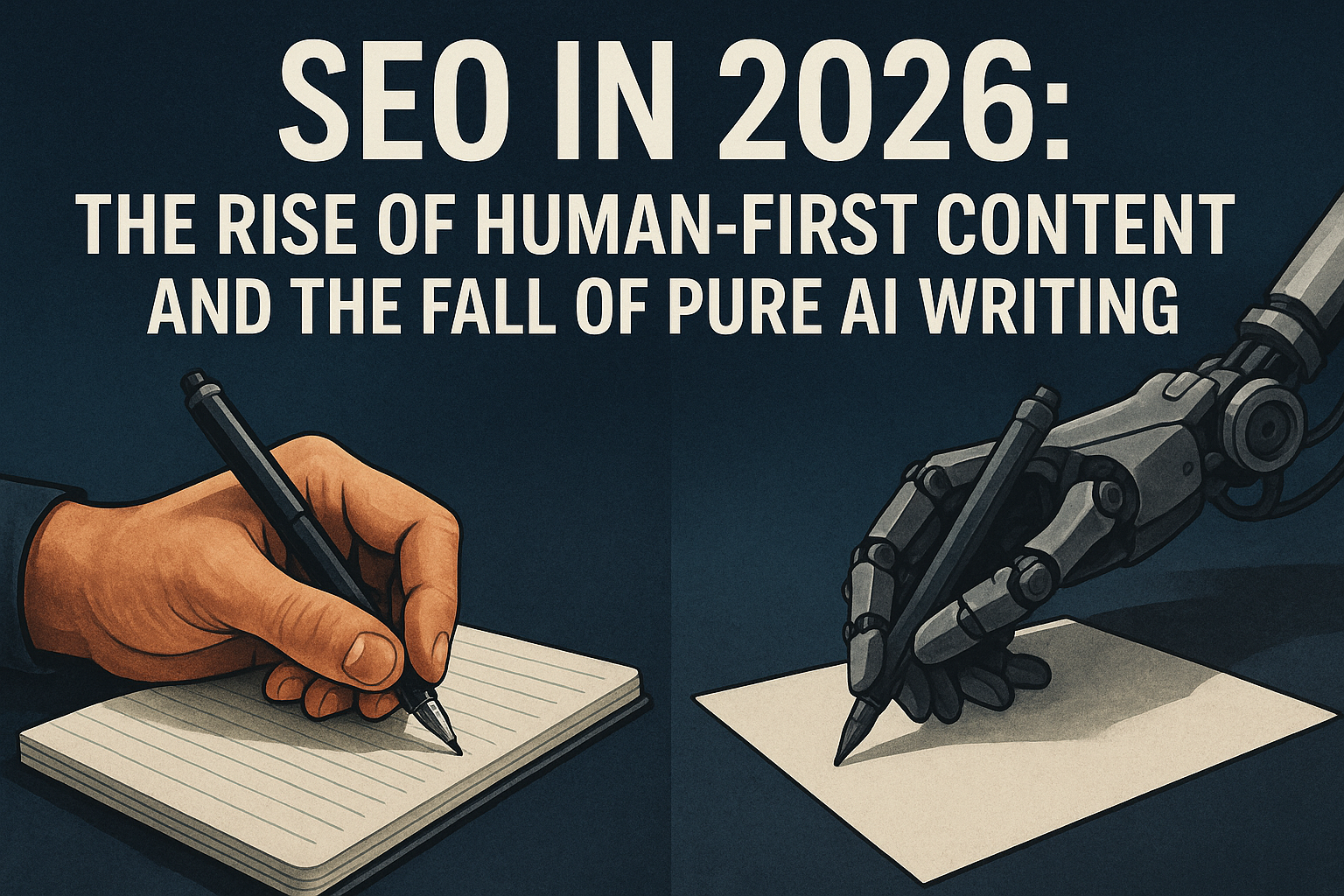
Why “HuSEO” Becomes the New Skill Every SEO Needs
In 2025, the AI writing engine had become an essential part of every search engine optimization (SEO) strategy. What used to take hours of concentration could now be drafted in minutes, and companies – regardless of their industry – were using large language models to extend the reach of their content teams. But as AI became ever more comfortable, something odd happened to the rankings. “Perfectly” structured articles slipped willy-nilly. Cleanly written pages with dense keyword stuffing got low time-on-page. Marketers found themselves “doing everything right, and losing ground.”
This created a new search engine optimization discipline: HuSEO or Human-First Search Engine Optimization. SEO teams were no longer publishing the raw output of AI, but instead refining drafts to bring back the depth, the music, the human-like experience that organic writers naturally produce. A whole new category of AI humanizers sprang up to help with the rewriting task. Platforms like GPTHumanizer AI, for example, attracted attention for their structural rewriting tools, but the broader shift wasn’t about any particular tool. It was about the increasing realization that in 2026, you had to write like a human if you wanted to rank.
Why Google Favors Human-First Signals in 2026
Google has been very clear that no one is “pigeonholed” who writes with AI. Google’s interest is in helpfulness, originality, and reader experience. The tricky part is raw AI content doesn’t naturally align with these ideals — not because AI writing is bad per se, but because it has a different style of expression than humans.
AI-produced text is smooth, it tends to have a regular rhythm and pace to its sentences. Transitional phrases appear in even intervals. The readability of AI-produced text is clean, but its regularity also makes it oddly bland. With updated quality systems, Google is aiming to improve the likelihood of getting results that appear formulaic, shallow, or “scaled” — because these patterns are statistically correlated with low engagement.
Human-first writing is messy. Human writing has contrast. Human writing has nuance. Sentence lengths vary. The emotional arc of a paragraph can change mid-way. Personal and contextual insights will appear that AI simply will not produce unless nudged to do so. These patterns are the signals Google cares about.
Table 1: Human-First vs Pure AI Writing Signals
| Dimension | Human-First Content | Pure AI Writing (Typical) |
| Sentence rhythm | Varied and less predictable | Smooth, uniform, balanced |
| Topical depth | Contextual nuance, lived experience | Generalized or simplified |
| E-E-A-T value | Shows perspective and expertise | Neutral, impersonal |
| Detector sensitivity | Lower due to natural variation | Higher when patterns are uniform |
| Engagement metrics | Better retention | Higher bounce rate for long-form |
These differences do not necessarily condemn AI writing. Instead, they explain why SEO teams increasingly need a “humanization” step before publishing.
The Fall of Pure AI Writing Workflows
Late 2024 and 2025 made a clear pattern in SEO communities. Blogs written by AI may rank fast for low competition keywords. But they fail. Some drop from top-three to page two with no clear reason. Others are alive with impressions but lose CTR. In all cases, engagement metrics lag one-shot human pieces.
The problem wasn’t that it was correct. AI text is famously correct, after all. It wasn’t that it was, though. It was that it didn’t feel human. Readers called it “boring,” “robotic,” “cautiously correct.” It answered questions, but not much else. Thousands of websites using the same generative models will end up with similar voices. Extensions swell.
Publishers used AI detection to see if they were, too. Not to punish, but to set a warning flag. Publishers started using AI detection to see if they were, too.Frequently, if the text comes out as “very AI-like, editors see that as a warning sign that the text may lack a natural rhythm. The industry had to retool. And in a different way. To “rebalance” the AI text—no, to enhance it—so it isn’t a robot, but a real writer.
The Rise of AI Humanizer Tools as a Middle Layer in SEO Workflows
Rather than abandon AI or entirely hand it over to human writers, SEO teams started using hybrid workflows. Humanizer tools became the middle step between writing and editing. They were not simply for paraphrasing, but for reengineering how the writing is being expressed so that it sounds natural, engaging, and personal.
Humanizers differ widely in how they work. Some do surface-level paraphrasing, swapping out keywords and shuffling clauses. Others do deeper rewrite approaches—altering the tone, reformatting the structure, and creating more varied linguistic patterns. A platform that does structural reformulation while maintaining meaning is GPTHumanizer AI. But the trend is broader than any one tool: SEO teams started to see humanization as fundamental to maintaining ranking stability and not leaving AI-like footprints that tend to signal poor engagement.
How to Practically Implement HuSEO in 2026
At the heart of a typical huSEO workflow is first drafting out an article with a large language model. This is a really good way to save time, and to ensure structural clarity. Next, the team humans improve the outline, i.e. the topical hierarchy, keyword placement, and user intent alignment. Then the article is processed with an AI humanizer tool – improving your text’s sentence rhythm and tone, and adding natural variation that AI has a hard time generating.
From there, we get back to human editors, who add specific examples, personal observations, data insights, or references to internal case studies. The final edit turns a generic AI draft into a human-first article that meets Google’s quality guidelines.
It isn’t about disguising the involvement of AI, but rather to increase quality. Many of our teams call this workflow “the best of both worlds” – the best of machine output and human authenticity.
When Human-First Content Produces Measurable SEO Results
An increasing number of SEO specialists report that adoption of HuSEO brings measurable positive results. Blogs that once suffered from a very high bounce rate had better retention when rewritten in a more natural voice. Some marketers observed that humanized content would attract more backlinks because readers considered it thoughtful instead of generic.
The largest improvements seem to happen in highly competitive industries, especially YMYL categories, where expertise and nuance are the most valued. Human first writing is a good way to signal authority and trustworthiness that pure AI writing cannot easily do without manual refinement.
AI Humanizer Tools Compared: Surface-Level vs Deep Rewriters
Because humanizers differ widely, SEO teams need to choose tools based on intent. Some tools are best for quick paraphrasing, while others are designed for deep rewriting.
Table 2: Types of AI Humanizers (with GPTHumanizer as an example)
| Feature Category | Surface-Level Paraphrasers |
|
| Rewrite method | Word swaps, phrasing tweaks | Structural reformulation and tone adjustment |
| Multilingual support | Limited in many tools | Usually broader across languages |
| SEO value | Keeps keywords intact but can sound robotic | Produces more natural, varied writing |
| Risk of semantic drift | Very low | Low to moderate depending on complexity |
| Use cases | Quick paraphrasing | SEO content refinement, blogs, long-form writing |
Choosing between them depends on workflow needs. For SEO, structural humanizers often produce more durable improvements because they affect deeper linguistic layers—rhythm, tone, and variety—rather than swapping synonyms.
Conclusion: HuSEO Becomes the Standard, Not a Trend
In 2026, success in SEO will depend not on how much content a team can produce, but on how human that content feels. AI is here to stay, but so is the growing expectation that writing must carry nuance, insight, and authenticity. AI humanizers—whether GPTHumanizer AI or others—are simply part of a broader movement toward restoring the human element in digital writing.
HuSEO is not a tactic. It is the new foundation of sustainable, reader-centered SEO.